Who is my MP? and The Lords, two free apps from Parliament's own data
Fifteen years after Dod's Parliamentary Communications, I went back to Westminster's data and built the two apps I wished had existed: one to find your MP, one to find peers by their specialisms.
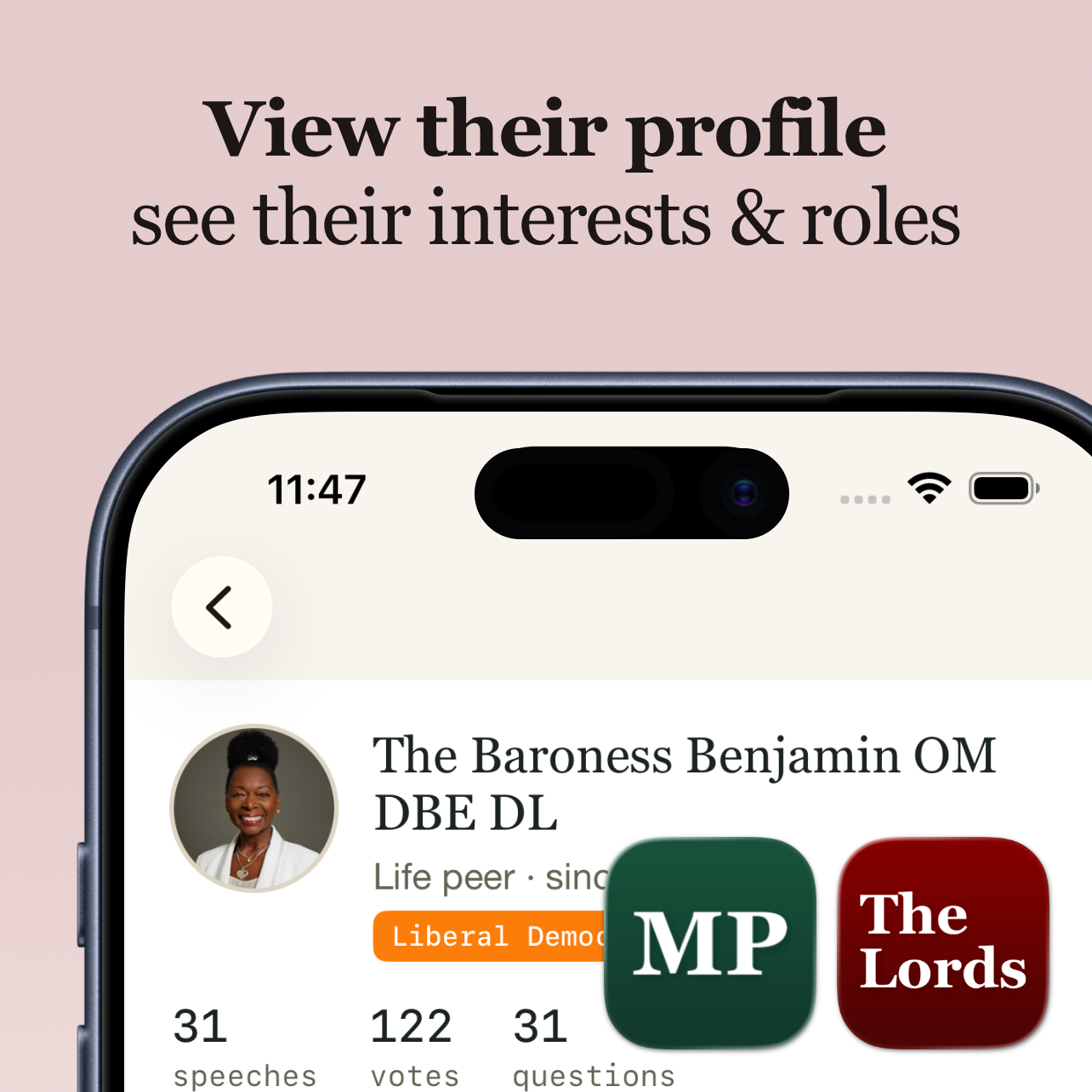
Who is my MP? It is one of the most searched questions about UK politics, and the answer has always been sitting in Parliament’s own open data. This year I built two free iOS apps on top of it: Who Is My MP?, which finds your MP by postcode, and The Lords, which helps you find members of the House of Lords by their specialist interests.
Why build a UK Parliament app now?
Fifteen years ago I was Lead Designer at Dod’s Parliamentary Communications, a departure from the ecommerce and advertising work I was used to. Instead of optimising CTR and conversion, the material was MPs, peers, select committees and the machinery of Westminster.
This year I went back to that world on my own terms. Everything Parliament publishes about both Houses (votes, speeches, written questions, registered interests, committee memberships) is free through Hansard and the Parliament data services. The data has been there for years. What is thin on the ground is a well designed way in for ordinary people.
Not a gotcha app
The easy version of an MP app is a gotcha: expenses, attendance leagues, who turned up least. I did not want to build that.
I wanted to show what MPs actually do, presented without editorial framing, and to be honest about the limits of the data. An MP with a low number of sitting days might also be a practising doctor, and the raw number tells you nothing about that. So the apps present the parliamentary record and let people read it in context, rather than ranking anyone. Neutral and non-partisan, with no spin.
How do I find out who my MP is?
Enter your postcode into Who Is My MP? and the app finds your MP and constituency. From there you get a full profile built entirely from Parliament’s own data:
how your MP has voted in the Commons what they have said in debates, straight from Hansard the written questions they have tabled their registered interests the select committees they sit on the roles they hold and their election results
Everything links back to the source on parliament.uk. It is written in SwiftUI with no third party packages, talking directly to the Parliament Members, Votes, Hansard and Written Questions APIs, with postcodes.io handling the postcode lookup.
Is there an app for the House of Lords?
The second app needed a very different approach. Nobody has “their” peer. The Lords is not organised by geography, so a postcode is no use. What peers do have is deep specialist knowledge: medicine, transport, the law, the arts, defence, the Windrush generation, palliative care.
So The Lords is browse-first. Instead of a search box and a blank screen, you start from topics and professions. Searching “end of life care” or “railways” maps onto the categories Parliament uses behind the scenes, so you find peers with a registered interest or professional background in that area, along with their voting record and register of interests.
It is the app you open when you think “who in the Lords actually knows about this?”
What the UK Parliament APIs taught me
The data is excellent and the documentation is patchy, a familiar combination. A few things I learnt the hard way:
The Commons votes API silently caps results at 25 per request, so pagination is not optional. Constituency names need normalising before search (ampersands, “and”, punctuation) or you get nothing back. In rural areas a postcode can sit a long way from where someone is standing, so location lookups need a widening fallback. Hansard search and Hansard overview endpoints use different parameter conventions for the same fields.
Both apps are free on the App Store now.
Who Is My MP? find your MP by postcode: https://whoismymp.uk The Lords, find peers by interest: https://thelords.app
If you work in politics, journalism, policy or civic tech, I would like to hear what you make of them, and what you would want a UK Parliament app to do next.